 Fishbowl Reps
Learn · 6 min read
What a river check-raise means at live low stakes
You bet the flop, the turn and the river with top pair, good kicker. The player who has called you all the way check-raises. It feels like you can't fold. At live low stakes, against a passive player, it is usually an easy fold.
The spot
Hand 4 of the Fishbowl Reps tutorial: you open A♦Q♠ from the cutoff and a passive regular calls in the big blind. The board runs A♣ 8♥ 5♦ 10♠ 3♥. You bet the flop and the turn and they call. On the river you bet 13 big blinds into 26, and they check-raise to 45.5.
Try it
Top pair, good kicker. You bet three streets. Villain check-raises the river.
The big blind is a passive regular: sticky, rarely bluffs. What do you do?
They had A♥3♠: the 3 on the river made two pair. Folding lost 26bb; calling would have lost 58bb.
Play this spot free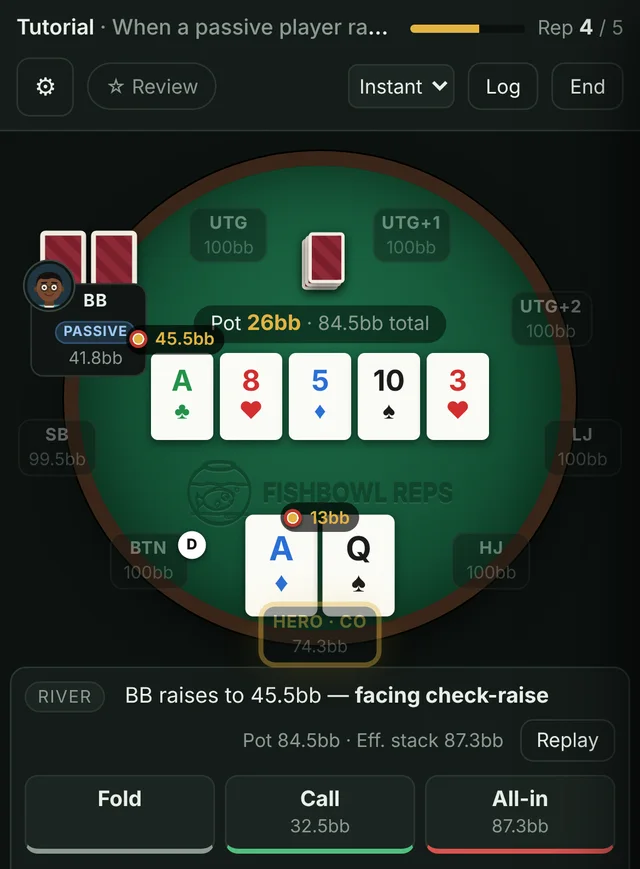
The math says you need them to bluff a lot
You have to call 32.5 big blinds to win a pot of 84.5. That's 32.5 out of a final pot of 117, so the call needs to win about 28% of the time. Since you beat none of their value hands, it's simple: more than about one raise in four has to be a bluff.
A balanced, solver-style player might get there. A passive live player doesn't come close.
Why passive players don't bluff-raise rivers
- Their bluffs look different. When a passive player bluffs, it's a stab after you show weakness: you check the flop, or you bet and then check the turn. Raising someone who has bet three streets is the hardest bluff in poker, and they don't make it.
- Raises late in the hand are value. Turn raises, river raises and check-raises from low-stakes regulars are two pair, sets and straights. That includes the small, "cheap-looking" raise: a 2 to 2.5x raise is still a real hand.
- They call with the hands that would bluff. A passive player with a missed draw or a weak pair just calls or folds. The check-raise range is only the hands that beat you.
What they actually have
On A-8-5-10-3, a river check-raise from a passive player is two pair (A-10, A-8, A-5 and A-3, like in the tutorial), sets (tens, eights, fives, threes) and the odd 4-2 that rivered a wheel. Every one of those beats A-Q. The hand that "worries" you, A-K, isn't in there much either, because a passive player with A-K usually just calls.
When you can call
- Aggressive or maniac players. Players who barrel and raise all the time do have bluffs here. The point is to know who you're playing.
- A real history. If you've seen this player show a bluff-raise, adjust. One story you heard about them doesn't count.
- Very short stacks. If the raise puts them nearly all-in and the price gets very cheap, the math changes.
"But I'll get exploited if I fold that much"
Only by someone who bluffs here, and the passive regular at your table isn't that player. Theory-based defense frequencies are for opponents who balance. Live low-stakes pools under-bluff big river raises badly, and the money you save by folding is real.
The short version
- You need about 28% equity to call. Passive players bluff-raise rivers far less than that.
- Turn and river raises from passive players are value, small raises included.
- Call against aggressive players, not against the one who called three streets.
Keep reading
- How to beat calling stations at live $1/$2
- The 6 player types at every live $1/$2 table (and how to beat each)
- Live poker tells that actually work at $1/$2
- How to Beat a Trapper in Poker: Lines and Counters
- Poker Timing Tells: What Tanks and Snap Calls Mean at $1/$2
- Hand Reading Poker: Drills and a Worked $1/$2 Hand
- Double Board Bomb Pot Strategy: A PLO Decision Guide