 Fishbowl Reps
Learn · 7 min read
Live poker tells that actually work at $1/$2
At a live $1/$2 or $2/$5 table, most players never think about what their timing, hands and voice give away. A tell won't tell you their exact cards, but it can tip a close decision. Here are the ones that hold up, what they usually mean, and how to use them.
First: what a tell is worth
A tell is a nudge, not proof. Even the reliable ones are right something like two times in three, and some players act weak when they're strong on purpose. Use them as a tiebreaker in close spots: when the bet sizing and the line already make it close, the tell decides. Never let a tell talk you out of a clear fold or a clear call.
The other rule: watch the player, not just the moment. Someone who always talks, always snaps or always stares isn't telling you anything. You're looking for a change from how they normally act.
Timing tells
- Snap call: they call your bet instantly. That usually means a medium hand that never considered raising, so you can take the very best hands out of their range. Good news if you're planning to bet again with a strong hand.
- Long tank, then a check on the river: usually weak. They're thinking about whether to bluff and decide not to, or they're hoping you check behind.
- Snap bet when the scary card hits: the flush or straight card comes and they bet instantly. Leans toward a bluff: a player who actually made the hand usually takes a moment to plan a size.
- Long tank, then a big bet or raise: at low stakes, more often strong. They're working out how much they can get paid. (Better players use this as an act, so it's less reliable against them.)
- Instant check: they've already given up on the pot. A good spot to bet.
More on timing, street by street and by player type: poker timing tells.
Physical tells
- Reaching for chips before you act: classic weakness. They're trying to stop you from betting by looking like they'll call anything.
- Looking away after betting: acting bored or disinterested usually means strength. They want you to call.
- Staring you down after betting: leans weak. They're trying to scare you out of the pot.
- Shaky hands putting chips in: strength. It's adrenaline from a big hand, not nerves from a bluff.
- Glancing at their chips as a card comes: they liked that card and are already planning a bet. Strength.
- Looking at their cards a long time, or several times, before raising preflop: usually not a premium. Players with aces or kings tend to glance once and stay still.
Verbal tells and table talk
- Lots of talking after they bet: relaxed and chatty usually means strong. Bluffers tend to go quiet.
- "I don't have the flush": naming a specific hand they don't have usually means they have something strong.
- "All-in?" asked like a question: when they're asking whether you'll go all-in, they usually want you to.
- "How much do you have behind?": ask it when they bet into you. Bluffers often answer eagerly and precisely, counting the stack out to the dollar. Strong hands tend to shrug ("enough") and barely move.
Try it
River. Villain bets, then looks away like they're bored. You ask how much they have behind.
They say "Enough." and barely lift a hand off the stack. Strong or bluff?
Two strength tells: the bored look away, and the reluctant, vague answer. In this hand from Fishbowl Reps they had nines full. (A third tell earlier in the hand, reaching for chips on the turn, pointed the other way. That's why tells are a nudge, not proof.)
Play this spot free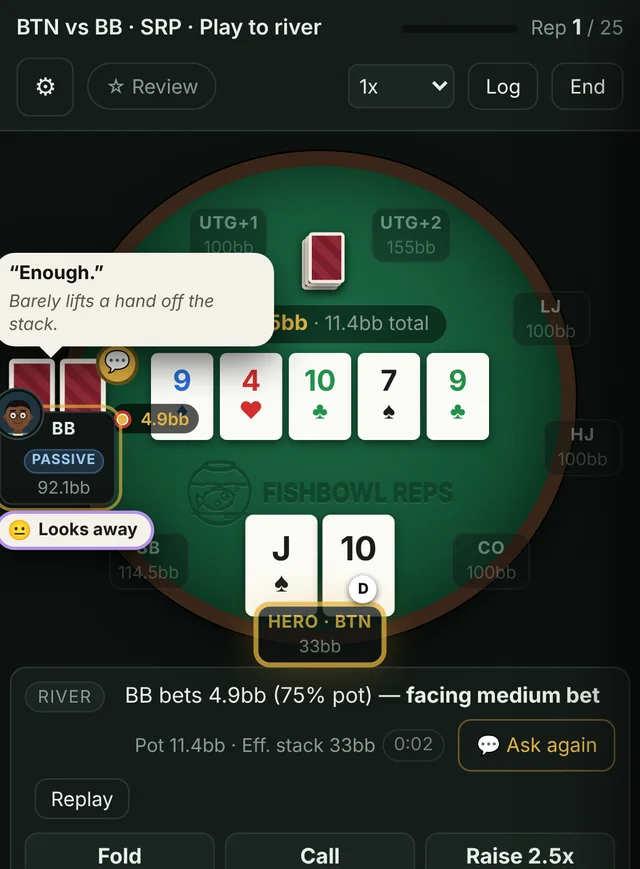
Bet-sizing tells
- Exactly double the last street: a quick, unplanned size. Leans toward a bluff.
- Size that matches their hand: at low stakes, especially on wet boards, big bets are often big hands worried about draws, and small bets are often weak or thin.
- Small bets in 3-bet pots: many players don't feel how much of their stack is going in, so overpairs and top pairs keep calling.
The short version
- Tells break ties. Don't let them override a clear decision.
- Look for a change from how the player normally acts.
- Weak: tank-check, reaching for chips, staring you down, snap bets on scary cards, eager precise answers.
- Strong: looking away, shaky hands, chatting after betting, "I don't have the flush", "All-in?" as a question.
Keep reading
- How to beat calling stations at live $1/$2
- What a river check-raise means at live low stakes
- The 6 player types at every live $1/$2 table (and how to beat each)
- How to Beat a Trapper in Poker: Lines and Counters
- Poker Timing Tells: What Tanks and Snap Calls Mean at $1/$2
- Hand Reading Poker: Drills and a Worked $1/$2 Hand
- Double Board Bomb Pot Strategy: A PLO Decision Guide