 Fishbowl Reps
Learn · 6 min read
How to beat calling stations at live $1/$2
The calling station is the player who makes live $1/$2 and $2/$5 worth playing. They call too much, fold too little and almost never raise. Most players still lose less to them than they should win, for one reason: they keep trying to make a station fold.
How to spot a calling station
- They call raises preflop from any position, with suited cards, small pairs and any ace.
- They call the flop with any pair or any draw, and the turn with most of them.
- At showdown they turn over second pair, bottom pair or ace-high and say "I had to see it".
- They rarely raise. When they do, it is a big hand (more on that below).
You don't need many hands to see it: one showdown where somebody called three streets with middle pair tells you most of what you need.
1. Value bet more hands, and keep betting
Against a normal player, top pair with a weak kicker is a hand you bet once and then try to get to showdown cheaply. Against a station it is a hand you bet three times, because the hands that call you are worse: second pair, a weaker kicker, a draw that missed.
The same goes for hands you'd check against anyone else: second pair on a safe river, an overpair on a board with a card higher than it, top pair after a scary turn. If a station would call with something worse, bet.
2. Bet big
Stations decide whether to call based on their hand, not on your bet size. Second pair calls a third of the pot and it calls three quarters of the pot. So the bigger bet is just more money from the same hands.
In the first hand of the Fishbowl Reps tutorial you have A♥K♦ on the button, and a station calls in the big blind. The board runs K♣ 7♠ 2♦ 4♥ 9♠. You bet every street, bigger each time, and the station calls all three, the last one 51 big blinds, with Q♥7♥: second pair. A small river bet there would have left most of that on the table.
Rules of thumb: 75% of the pot on the flop and turn with strong hands, and don't be afraid of pot-sized or bigger river bets with top pair good kicker or better.
Try it
You have A♥K♦. Board K♣ 7♠ 2♦ 4♥ 9♠. The station called the flop and the turn. River:
The big blind is a calling station. What size do you bet?
A station who called two streets has a pair or better, and a pair calls a big bet just as often as a small one. In the tutorial the station had Q♥7♥ and called 51bb on the river.
Play this spot free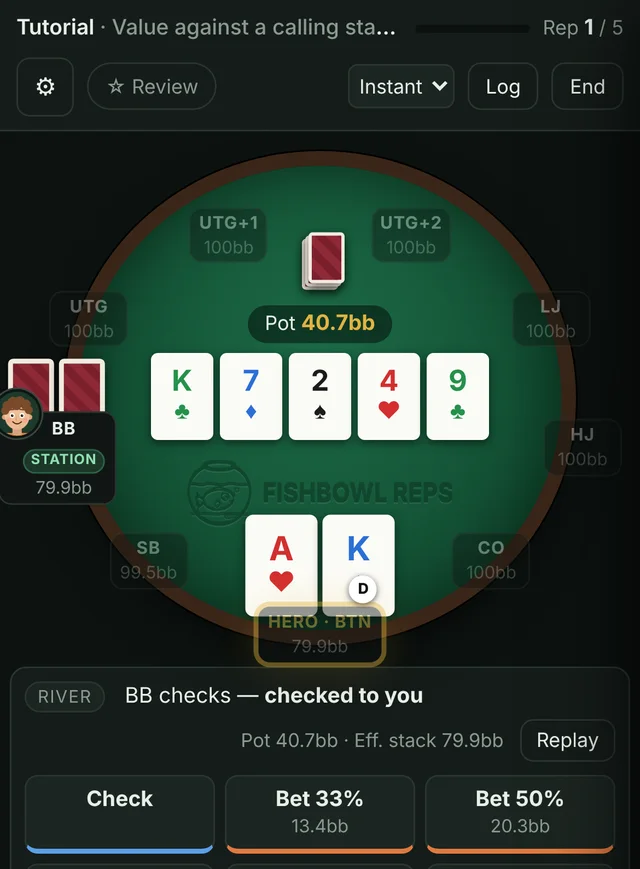
3. Stop bluffing them
This is where the money leaks back. A bluff only works if the other player folds, and the whole point of a station is that they don't. Semi-bluff with real draws if you like, but when you miss, give up. The river bluff into a station is the most expensive habit at a live low-stakes table.
The flip side: you can stop paying to find out. You almost never need to "make a move" against a station. Wait for a hand, then bet it.
4. When a station raises, believe it
A player who calls with everything and suddenly raises is telling you something. Turn and river raises from stations are two pair, sets and better far more often than bluffs, and a min-raise is no different. Top pair is a fold more often than it feels like it should be.
5. Get heads up with them
Stations make the most money for you in heads-up pots where you have position. When a station limps, raise your value hands bigger than usual (they'll call anyway), so the rest of the table folds and you get a pot against them alone.
The short version
- Bet more hands for value, on all three streets.
- Bet bigger: their calls don't depend on your size.
- Don't bluff them. Give up when you miss.
- Believe their raises.
Keep reading
- What a river check-raise means at live low stakes
- The 6 player types at every live $1/$2 table (and how to beat each)
- Live poker tells that actually work at $1/$2
- How to Beat a Trapper in Poker: Lines and Counters
- Poker Timing Tells: What Tanks and Snap Calls Mean at $1/$2
- Hand Reading Poker: Drills and a Worked $1/$2 Hand
- Double Board Bomb Pot Strategy: A PLO Decision Guide